Since the beginning of winter, the oily and acne situation that has bothered me for a long time has been much less, and the skin condition has also stabilized a lot, which is a blessing in disguise.
But this stability is temporary after all. When spring and summer arrive, my skin will be knocked back to its original state. (As for why I am so sure, I will go through this cycle every year...)
What can we do to keep the good state of winter and keep the skin stable and online all year round?
"In winter, if you want to restore the good state of your skin (correct" homeostasis "), the first thing is to moisturize, and the second thing is to gently acidify the skin surface"
We still have to talk about how to do it specifically.
Oily skin in winter:
The "illusion" of good skin
The main reason why many oily-skinned sisters fall into a cycle of skin care is that external stimuli (such as strong ultraviolet rays and high temperatures) in winter are greatly reduced, and the surface problems of skin are temporarily "suppressed", but they are not really solved.
In fact, for oily skin, the biggest headache is too much oil and repeated acne, especially in spring and summer, when this problem will reach its peak. Persistent high temperatures will constantly stimulate sebaceous glands to work wildly, causing sebum secretion to get out of control completely.
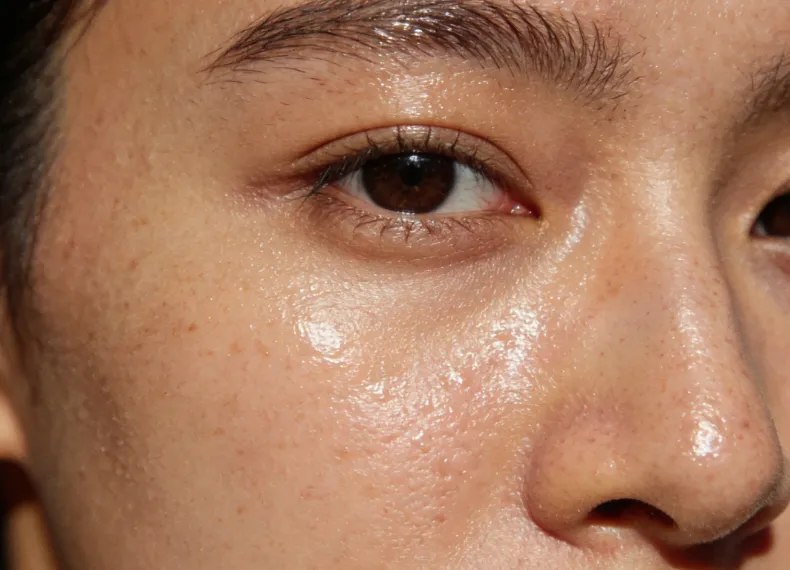
These excess oils provide an excellent hotbed for oleophilic bad bacteria such as Malassezia, breaking the microbial balance on the skin surface and allowing bad bacteria to "gain the upper hand".
The metabolites of these bad bacteria will in turn irritate the skin and cause inflammation. Coupled with squalene in sebum, after ultraviolet irradiation, it is particularly prone to peroxidation and generate a large number of pro-inflammatory substances, further amplifying inflammatory signals. Under the internal and external attack, our skin will become sensitive, red, and acne will break out at every turn.
In this way, inflammation is no longer a "one-off" minor problem. Instead, it will turn its head around to stimulate sebaceous glands. The more oil it produces, the more severe the inflammation; The heavier the inflammation, the fiercer the oil production, and eventually it falls into a vicious circle that can't be stopped.
But in winter, things are quite different.
The dry climate environment may seem unfriendly, but it has helped us a lot. The oil output is significantly reduced, which brings two key benefits:
1. Sebum secretion is reduced, bad bacteria such as Malassezia lose their "rations" for survival, the reproduction speed is greatly slowed down, and the risk of microbial imbalance is also reduced.
2. The total amount of squalene in the skin becomes less. Even if it is exposed to ultraviolet rays, the pro-inflammatory substances produced by oxidation are less, which will not activate the inflammatory pathway of the skin on a large scale.
But this seemingly stable state does not mean that the skin has really become healthy. The problems caused by low-grade inflammation at the bottom have not really been solved.
This also means that if we don't take the initiative to intervene in winter, acne bursts and oil flooding in spring and summer will still come as scheduled. Isn't there anything we can do?
In fact, the solution is just around the corner-autumn and winter are the best times to nourish oily skin.
The golden period of skin acidification
You know, the low temperature and low humidity environment in autumn and winter has helped us clear a big obstacle-excessive sebum secretion. Therefore, the next core task is very clear, that is, to actively solve the hidden dangers of inflammation hidden at the bottom.
According to the literature I found, the most worry-free and efficient strategy is to gently acidify the skin.
I believe the neighborhood already knows a lot about surface acidification, which is the first step to establish skin homeostasis. But for our oily skin, the benefits of acidification are more direct and symptomatic. That is to help us effectively control inflammation, inhibit the reproduction of harmful bacteria, and strengthen the skin barrier from the root cause, instead of just doing superficial efforts.
@ Rabbit mentioned in the article two days ago that the microecology of the skin surface is particularly susceptible to pH. Then let's think about it from another angle. If we regulate the microecology in advance in autumn and winter, can we make the skin develop a "resistant constitution" in advance?
The answer is yes, healthy skin is inherently weakly acidic (pH ≈ 5. 5), and this weakly acidic environment is particularly conducive to beneficial bacteria settling down on the skin surface.
They will not only seize the living space of harmful bacteria, but also secrete a large number of antibacterial peptides and short-chain fatty acids as the main force to protect the skin, stopping the invasion of harmful bacteria from the source.
When the number of these harmful bacteria is controlled, the pro-inflammatory substances produced are reduced, and the inflammatory response is naturally reduced accordingly.
And for oily skin, mild acidification has another hidden benefit: it can quietly regulate the rhythm of keratin metabolism.
Many problems with oily skin are actually not simply too much oil, but old dead cutin + excess oil pasted together. Gentle acidification can help the stratum corneum shed in an orderly and gentle manner, preventing keratin accumulation, thus reducing the risk of pore clogging.
Therefore, as long as we seize the golden period of skin acidification in autumn and winter and adjust the skin to a healthy steady state, even if the temperature rises in spring and summer, the skin will be more stable and less prone to sensitivity and acne.
Many neighbors who have used lactobionic acid have reported that if they insist on using it in autumn and winter, not only will their skin be softer and smoother, but their mouth will be less closed, and even the redness and tingling pain during the change of seasons will be significantly reduced.
It is equivalent to "one conditioning, worry-free all year round", so you don't have to wait until the skin rolls over in spring and summer before spending a lot of money to remedy it.
Life Proposal
Of course, all skin care methods are based on "healthy diet and regular work and rest". Especially for oily skin, in addition to the inflammation on the skin surface, we must also pay attention to the low-intensity inflammation in the body!
The high-sugar, high-oil and high-fat diet under our key name, coupled with staying up all night, will disrupt the rhythm of sebum secretion. Even if you insist on acidification, the skin care effect will be greatly reduced.
Therefore, today's life proposal combines the two aspects of diet + skin care. Only by taking a two-pronged approach can the skin be more stable.
1. Control sugar and oil, and eat more anti-inflammatory things:
● Reducing the intake of high-sugar and high-fat foods, especially fried foods, can easily aggravate squalene oxidation and block pores.
● Eat more vegetables and cereals with high dietary fiber. Dietary fiber can stabilize blood sugar and reduce sebum secretion. (Neighbors who don't want to toss can eat miscellaneous grain porridge directly like me) 🤫
● Appropriate supplement supplementOmega-3 fatty acids, curcumin and chlorogenic acid, can effectively help the body inhibit the inflammatory response.
2. Mild acidification + intensive moisturizing:
● A large amount of milk base + b 5 thin coating, with lactobionic acid cream, can not only further moisturize the skin, but also gradually help pull the pH value of the skin back to weak acidity. (You can also try the combination of succinic acid + baby cream for oily skin, which is more refreshing ~)
● During skin care in the evening, use the same milk water + b 5 as the base, add two drops of firming essence oil to lactobionic acid cream, mix and apply to the face to further strengthen moisturizing. (My skin will be dry in winter, so my skin will be softer the next day if I mix it on my face) 🧐
Finally, skin care is not something that can be accomplished overnight. Acidification + life conditioning in autumn and winter is the process of laying the foundation for the skin.
I wish all friends and relatives a healthier skin, better complexion and good spirits this winter ~
Disclaimer
- 1. This website aims to popularize skincare knowledge for readers;
- 2. The popular science content cannot replace doctors' diagnosis opinions, and is for reference only; If you have skin problems, please consult a professional doctor in time;